
The annoying myth of the shiny new book reveal with accompanying photo of smiling author (& what I thought I might do about that).
by ali whitelock

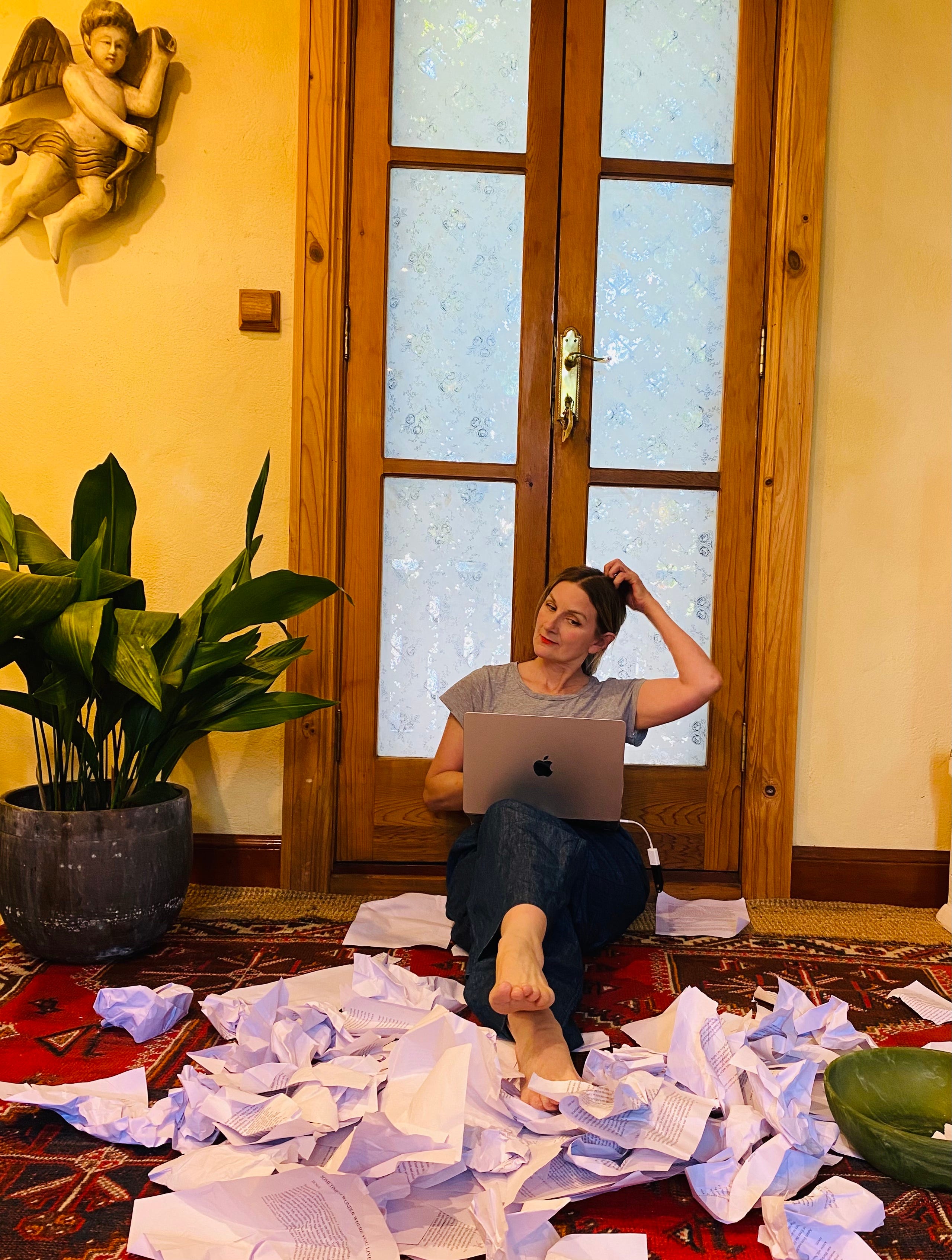
We’ve all been there. You know, on socials, where mostly what we see are photos of happy smiling authors holding their shiny, newly released books. As if the books just appeared as easily and perfectly as Nigella Lawson might produce a flourless chocolate cake, ie., without splattering chocolate batter on the ceiling, or, indeed, the cat. Ah, social media, how perfectly airbrushed and effortless you make it all look. But, as most of us know, writing a book is, Very. Fucking. Hard. And far from effortless. In my case, it usually comes with a good dose of gastric reflux and the occasional hiatus hernia.
That’s not to say it’s not nourishing, delicious and downright rewarding. But we are so used to hiding the underbelly of life’s difficult stuff, it’s as though to expose it would be an admission of weakness, or worse, that we aren’t super human after all––despite instagram’s best efforts to convince our followers that we are. A writer I know says, with every book he writes, he loses ten years of his life. Which is closer to the truth of things than what instagram would have us believe. But before we get too far into this, let me apologise for the potentially excessive use of exclamation marks to come (!). Some people love ‘em. Personally, I hate them. They’re a bit like gin, (which, let’s be honest, is akin to drinking draino) but sometimes you just really need one.
And so, in the spirit of sharing my own writing and editing process, I popped a post on my socials. The post talked about how I was at the pointy end of my latest manuscript and I wanted to share a visual representation of what that looked like. I thought it might keep things real and be interesting to other writers, as well as readers, to see what a writer’s process is like––a lifting of the frilly drapes, if you will. People are gonna love that, I thought. And most of the people did.
The photo I shared in the post is the same one I’ve shared here. Me, sitting on the floor, macbook on my lap, surrounded by a mess of discarded sheets of A4 paper. This is how I work––
once the manuscript is printed out, I read each chapter from the page, meticulously, line by excruciating line. I say excruciating, because when you’ve read your own work over and over and over, you can get very fucking tired of it. In my experience of writing and publishing since 2008, printing out a manuscript on paper when the time and phase is right, is crucial. Every writer I know does this. That doesn’t, of course, mean that every other writer does this too.
As I read the manuscript, I start shaving off all the crap. I hack off limbs no longer serving any purpose. As I read, I scrunch pages no longer required into balls, tear others into strips, toss them on the carpet around my writing table with delirious gay abandon. What I’m doing is, I’m getting rid of the excess fat, cutting loose the padding that helped get the story down but is now, very evidently, not good enough to be allowed to stay. And it makes me so happy to see all that disgusting (a bit strong, I know) excess crap being cut away. The new, improved, leaner version of my manuscript starts to emerge, I wanna say like a statue of David from a lump of marble, but, come on, we all know that’s way too grandiose for a manuscript with my name attached to it.
With all that ruthlessly discarded paper around my bare feet (this is Australia, bare feet are practically compulsory and, weirdly, liberating), I have entered the phase of the process that tells me, I’m getting there, I’m getting there. As I move through the coming days and weeks I love to wade through that crunchy pile. How I love to boot those paper balls and see them bounce off the walls. I imagine myself kicking goal after goal, the crowd roaring in appreciation. Reader, I wallow in all that discarded shit like a fat hippopotamus in a muddy water hole for weeks and weeks and fucking weeks. I celebrate my daily slashing with a glass of sparkling wine (sadly, my budget doesn’t stretch to champagne)–– aforementioned draino, I mean, gin, being reserved for when times feel impossibly tough. But in this phase, this lighter phase, I straddle these two worlds of the old fat manuscript and the new slimmer model for a long time, some might argue too long, prolonging that feeling of, I’m getting there, I’m getting there.
But everyone’s process is different, well, maybe not everyone’s, but I guess some of us have a few quirks and different ways of approaching our writing. Someone gave me a book once on the writing rituals of a selection of artists and writers. While most of the writers’ processes were much like my own, (wake at 7am, have a coffee, get to desk by 8am, work till 11am, go for a walk, blah blah blah, predictable and very routine) one of them said she could only write with snails down her bra.Which makes my own process, and perhaps yours, appear rather banal by comparison.
So on my socials, the first comment was from a writer and it said, how many trees have you killed doing this? With another commenter adding, the simple but weird, (and pointless), trees are sad. Reader, I’m surprised you didn’t hear me groan from wherever you are reading this post. I guess at some level I expected comments like this, but that didn’t stop my eyes from rolling. In fairness, the first commentator wished me well, although she, clearly being morally and spiritually superior to other writers, did not, she advised, use any paper in the process of writing a book. I wonder how she feels about the trees that go into publishing her resulting books (which, I hate to point out, are made of, ahem, paper). Perhaps she only does e-books. Go her and her paperless principles.
My response to these comments was that printing a manuscript out in full, on, yes, actual paper made from actual trees, is a necessary part of the process and if you’re not doing that, you’re not giving your manuscript the best chance. When we read our own writing on a screen, our brains fill in the words that are missing, they skip over typos, anticipate what the text should say, when it doesn’t say that at all. When reading from a screen you simply will not hear the lack of rhythm, won’t stumble on the wrinkles in the rugs, nor trip over plant pots inadvertently left in the middle of the hall. Because as writers our brains are so used to our own work, our eyes will glide over all of its foibles. We are rendered unable to read our own work critically.
I would argue that another crucial part of the process is to read your own work aloud, preferably in a room by yourself. And never, ever, read it to someone who loves you (this is a topic for a future Substack). As you read, feel the words as they leave your mouth, listen to their music. Until I’ve gone through this process myself and I’m satisfied that the work is the best I can make it, only then will I share my writing. As Vladimir Nabokov famously said, ‘Only ambitious nonentities and hearty mediocrities exhibit their rough drafts. It's like passing around samples of sputum.’ Jeez. If ever there were a phrase to make your hair curl with devastating anxiety, this would surely be it. I heard this quote way back in the beginning of my writing life and the idea of sharing work that is not quite finished still sends the fear of God right through me. But that’s just me––I know we now live in the era of poets who write poems on their iPhones on the bus on the way to the open mic and read them (from their iPhones) to a room full of people. And while I’m sure aspects of these poems can be clever and moving, anything that’s written down for the first time on an iPhone on the bus is, I’d hazard, 99% of the time going to need some work, some crafting, a little blood on the keys, if you will. Unless of course you are a genius, and I concede that those kinds of people do actually exist.
Now, to address the other comments in my feed such as trees aren’t happy. For the record, I too care about trees. But I think, as a writer, printing out 100 x A4 pages every three years and scrunching up what’s not required is absolutely fine. If my critics really want to go down this path, they might like to know that I probably offset my shocking paper indulgence and tree cruelty by not buying packaged foods, nor do I buy take-away sandwiches in brown paper bags every day for lunch, nor do I drink daily coffees in take-away cups. For all those tree huggers out there (and I’m one of them) 100 pages of A4 is a tiny fraction of what most (the critics on my FB page no doubt) are discarding in their every day lives. But that’s ok! (sorry, it’s getting close to me needing a gin!). They too have the right to use as many take away cups as they like! (Yikes, there’s another.) Hopefully, as my critics sip on their take-away caramel frappés, no-one on the street is haranguing them about their outrageous overuse of paper cups with comments such as how many fucking trees have you killed in order to enjoy your frappé? Closely followed by trees are sad. So as they pile their yearly, 365 take-away cups into landfill, along with their 365 grease soaked brown paper sandwich bags, it’s for all those morally superior writers to live with their own tree-saddening contradictions. And for me to live, happily, with mine.